Fertility Supplements for Women Over 35: The Complete Protocol


Fertility Supplements for Women Over 35: The Complete Protocol
If you're over 35 and trying to conceive, you've likely heard the phrase "advanced maternal age" more times than you care to count. But here's what the data actually tells us: fertility supplements for women over 35 can make a meaningful difference to egg quality, hormonal balance, and your chances of a successful pregnancy — when you choose the right ones. This guide breaks down the science, the specific nutrients that matter most, and how to build a complete protocol that supports your fertility at 35 and beyond.
Fertility over 35 is not a lost cause. It's a different game, one that requires more strategic support. Understanding what changes in your body — and how targeted supplementation addresses those changes — is the first step to giving yourself every advantage.
What Actually Changes in Female Fertility After 35
Before diving into which fertility supplements for women over 35 to take, it helps to understand exactly what's happening biologically. Three key changes occur as you move into your mid-thirties:
Declining egg reserve. You're born with all the eggs you'll ever have. By 35, both the quantity and quality of those eggs begin declining more rapidly. AMH (anti-Müllerian hormone) levels, which reflect ovarian reserve, typically drop after 35. Antral follicle counts decrease too. This doesn't mean you can't conceive — millions of women do — but it does mean eggs need more nutritional support.
Increased oxidative stress. As eggs age, they become more susceptible to damage from free radicals — a process called oxidative stress. This can affect chromosomal integrity, which is why miscarriage rates and chromosomal abnormalities are higher in older pregnancies. Antioxidant supplementation directly counters this effect.
Mitochondrial decline. Eggs are among the most mitochondria-rich cells in the body. Mitochondria produce the energy (ATP) needed for fertilisation and early embryo development. After 35, mitochondrial function in eggs decreases — which is why CoQ10 has become one of the most researched fertility supplements for women over 35.
Understanding these three mechanisms helps explain why a simple prenatal vitamin isn't always enough once you're past 35. You need targeted, evidence-based support for egg quality, hormonal function, and cellular energy.
CoQ10: The Mitochondrial Booster Every Woman Over 35 Needs
Join thousands of couples who've made Conceive Plus part of their fertility journey. Clinically formulated, science-backed, and designed for people just like you.
Shop Conceive Plus Now →
Coenzyme Q10 (CoQ10) is arguably the most important egg quality supplement for women over 35. Here's why it tops the list:
CoQ10 is a fat-soluble antioxidant naturally produced in the body, but levels decline with age. In the ovaries, CoQ10 helps eggs generate the energy needed for successful fertilisation and early cell division. A landmark study published in Aging (2015) found that supplementing aging mice with CoQ10 improved ovarian reserve, egg quality, and fertilisation rates significantly. Human studies have since supported these findings.
A clinical trial published in Fertility and Sterility (2017) evaluated CoQ10 supplementation in women undergoing IVF. Women who supplemented with CoQ10 prior to their cycle produced more eggs, had higher fertilisation rates, and experienced better embryo quality compared to controls. A 2018 meta-analysis confirmed that CoQ10 is associated with improved ovarian response in women with diminished ovarian reserve — precisely the situation many women over 35 face.
The recommended dose for fertility is typically 200–600 mg per day of ubiquinol (the active, pre-converted form). Ubiquinol is more bioavailable than ubiquinone, making it the superior choice for fertility supplementation. Most women should start CoQ10 supplementation at least 3 months before trying to conceive, as egg maturation takes approximately 90 days.
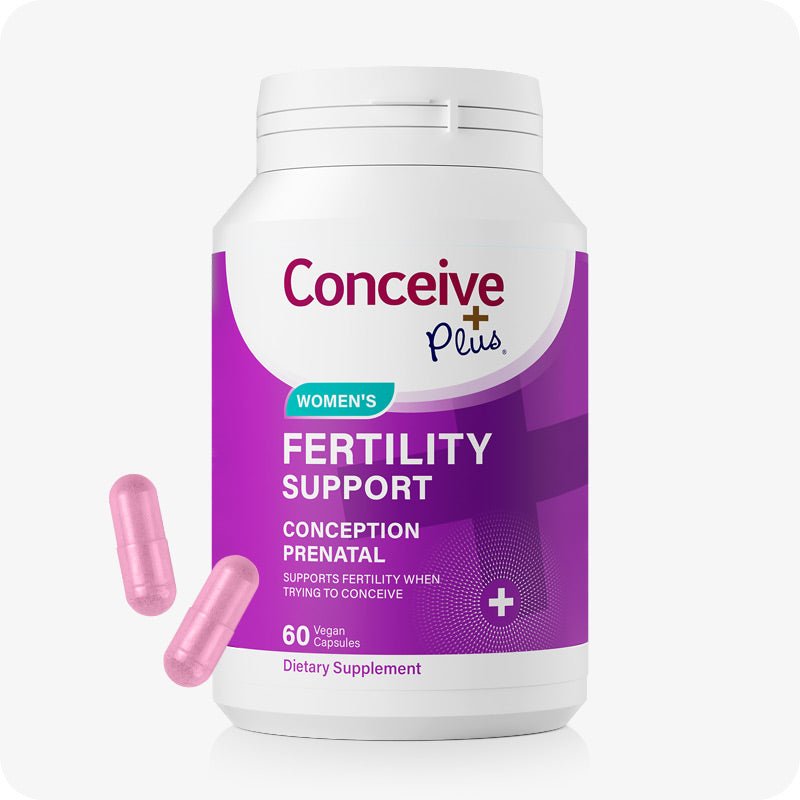
Conceive Plus fertility supplements for women include CoQ10 as a core ingredient, formulated for bioavailability and combined with synergistic nutrients that support the same pathways.
Folate vs Folic Acid: Why Your Supplement Choice Matters After 35
If you're looking at fertility supplements for women over 35, you've probably seen both "folic acid" and "folate" on labels. They're not interchangeable — and the difference matters significantly, especially as you get older.
Folic acid is the synthetic form of folate. To be used by your body, it must be converted into active 5-MTHF (methyltetrahydrofolate) by an enzyme called MTHFR. Here's the problem: up to 40-60% of people carry a common MTHFR gene mutation that impairs this conversion. This is particularly relevant for women trying to conceive, because insufficient active folate can affect egg quality, early embryo development, and significantly increase the risk of neural tube defects.
Methylfolate (5-MTHF) bypasses this conversion entirely. It's the bioactive form your body can use immediately. Research published in the Journal of Maternal-Fetal and Neonatal Medicine (2019) found that women taking methylfolate had higher blood folate levels than those taking equivalent doses of folic acid, regardless of MTHFR status.
For women over 35, this matters even more. The efficiency of enzymatic processes tends to decline with age, meaning the conversion of folic acid to active folate may be less reliable. Choosing a fertility supplement that uses methylfolate rather than folic acid is a straightforward upgrade that costs nothing extra but may make a significant difference.
Conceive Plus women's fertility supplements are formulated with methylfolate — not folic acid — to ensure bioavailability regardless of your genetic profile.
Vitamin D: The Overlooked Fertility Hormone
Vitamin D isn't just for bones. It functions more like a hormone than a vitamin in the body, with receptors found throughout the reproductive system — including on the ovaries, uterine lining, and follicular cells. A growing body of research identifies vitamin D deficiency as a significant fertility factor, particularly among best fertility vitamins over 35 candidates.
A 2019 systematic review and meta-analysis published in Human Reproduction Update found that women with sufficient vitamin D levels had significantly higher clinical pregnancy rates in IVF cycles compared to vitamin D-deficient women. Vitamin D appears to support follicular development, oocyte quality, and endometrial receptivity — all critical for implantation.
Deficiency is startlingly common. Studies estimate that 40-70% of women of reproductive age have suboptimal vitamin D levels, with deficiency more prevalent among those living in northern latitudes, people with darker skin tones, and those who spend limited time outdoors. After 35, the body's ability to synthesise vitamin D from sunlight also decreases.
The recommended supplemental dose for fertility is typically 2,000–4,000 IU of vitamin D3 daily, though your optimal dose depends on your baseline levels. Getting a blood test (25-hydroxyvitamin D) before supplementing allows you to calibrate your dose accurately.
Inositol for Egg Quality and Hormonal Balance
Inositol — particularly the combination of myo-inositol and D-chiro-inositol — has emerged as one of the most compelling fertility supplements for women over 35, especially those with irregular cycles, PCOS, or concerns about insulin sensitivity.
Inositol is a naturally occurring sugar alcohol that plays a central role in insulin signalling and follicle-stimulating hormone (FSH) signal transduction. In the context of fertility, it supports the pathway through which FSH promotes follicular development and egg maturation. Research published in the European Review for Medical and Pharmacological Sciences found that myo-inositol supplementation significantly improved oocyte quality, fertilisation rates, and embryo quality in IVF patients.
For women over 35 specifically, a study published in Gynecological Endocrinology (2018) found that myo-inositol supplementation improved both oocyte and embryo quality in poor ovarian responders — a population that often overlaps with women of advanced maternal age. The study noted improvements in fertilisation rate and a higher proportion of mature (MII) oocytes in supplemented women.
The standard research dose is 4,000 mg myo-inositol combined with 400 mg D-chiro-inositol daily, mirroring the physiological ratio found in ovarian follicular fluid. Conceive Plus women's supplements incorporate inositol alongside the other key fertility nutrients, providing a convenient all-in-one approach.
Complete Protocol: Building Your Fertility Supplement Stack
Based on the clinical evidence reviewed, here is the recommended fertility supplements for women over 35 protocol:
1. CoQ10 (ubiquinol form): 200-600 mg/day
Start 3 months before TTC. Supports mitochondrial function and egg quality. Take with meals containing fat for optimal absorption.
2. Methylfolate (5-MTHF): 400-800 mcg/day
Avoid folic acid. Essential for neural tube protection and healthy egg and embryo development. Begin before you're actively trying — ideally 3 months prior.
3. Vitamin D3: 2,000-4,000 IU/day
Test first if possible. Supports follicular development, oocyte quality, and endometrial receptivity. Always take with K2 for proper calcium metabolism.
4. Inositol (myo + D-chiro): 4,000 mg + 400 mg/day
Particularly valuable for irregular cycles or PCOS. Supports FSH signalling and oocyte quality.
5. Omega-3 fatty acids (DHA/EPA): 1,000-2,000 mg/day
Anti-inflammatory, supports hormonal balance, and critical for early brain development. Choose a molecularly distilled fish oil or algae-based omega-3.
6. Vitamin E: 400 IU/day
Potent antioxidant. Works synergistically with CoQ10 to reduce oxidative damage to eggs. Use the natural d-alpha tocopherol form.
7. Zinc: 15-25 mg/day
Essential for egg maturation and cell division. Most comprehensive prenatal vitamins include zinc; check your label.
Conceive Plus women's fertility supplements are formulated to cover these key bases in a single, comprehensive product — eliminating the complexity of managing multiple individual supplements.
Conceive Plus fertility supplements are formulated with the evidence-based nutrients your body needs — including methylfolate, CoQ10, inositol, and vitamin D3 — in bioavailable forms proven to support egg quality and hormonal balance.
Shop Conceive Plus Fertility Supplements →
Lifestyle Factors That Amplify Your Supplement Protocol
Supplements work best as part of a comprehensive fertility strategy. While CoQ10 fertility women research is compelling, the following lifestyle factors amplify the benefits of supplementation:
Sleep: Melatonin is a powerful antioxidant produced during deep sleep and has been found in follicular fluid. Poor sleep raises cortisol, which disrupts hormonal balance. Aim for 7–9 hours of quality sleep in a dark room.
Anti-inflammatory diet: A Mediterranean-style diet — rich in olive oil, leafy greens, fatty fish, nuts, and whole grains — has been associated with higher IVF success rates in multiple studies. It reduces oxidative stress and inflammation that can impair egg quality.
Exercise: Moderate, regular exercise (150 minutes/week of moderate-intensity activity) improves insulin sensitivity and reduces inflammation. However, excessive high-intensity exercise can suppress reproductive hormones — the evidence suggests "enough but not too much" is the right balance.
Stress management: Chronic stress elevates cortisol and can disrupt the HPG (hypothalamic-pituitary-gonadal) axis that regulates ovulation. Practices like mindfulness meditation, yoga, and acupuncture all have some evidence supporting benefits for fertility stress management.
Alcohol and caffeine: Evidence suggests that more than 2 alcoholic drinks per week may affect fertility, and excessive caffeine (>200 mg/day) has been linked to reduced fertility. Minimising both during your TTC journey is a worthwhile precaution.
When to See a Fertility Specialist
If you're over 35, current guidelines recommend seeking a fertility evaluation after 6 months of regular, unprotected intercourse without conception (compared to 12 months for women under 35). This isn't pessimism — it's pragmatism. Earlier investigation gives you more options and more time.
Key tests to ask about include:
- AMH (anti-Müllerian hormone) — reflects ovarian reserve
- Antral follicle count (AFC) — ultrasound assessment of egg supply
- Day 3 FSH and oestradiol — assess pituitary-ovarian communication
- Progesterone (day 21) — confirms ovulation
- TSH (thyroid) — thyroid dysfunction is a common and treatable cause of subfertility
- MTHFR gene test — if you want to confirm you're taking the right form of folate
Starting fertility supplements for women over 35 now doesn't mean waiting for test results. You can begin a supplement protocol while pursuing testing, as most fertility-supportive supplements are safe to continue throughout TTC and early pregnancy (always check with your doctor).
Frequently Asked Questions
Q: Do fertility supplements for women over 35 actually work?
A: Yes — with caveats. Specific nutrients like CoQ10, methylfolate, inositol, and vitamin D have clinical evidence supporting their roles in egg quality, hormonal balance, and fertility outcomes. They cannot reverse age-related decline entirely, but they can meaningfully support the function of the eggs you have.
Q: How long should I take fertility supplements before trying to conceive?
A: The standard recommendation is 3 months (90 days) minimum, as this covers one full egg maturation cycle. Starting 3–6 months before actively trying is ideal.
Q: Is CoQ10 safe to take when trying to conceive?
A: Yes. CoQ10 is well-tolerated and generally considered safe for pre-conception use. It's typically discontinued after confirmed pregnancy, though no clear harm has been demonstrated. Always discuss with your healthcare provider.
Q: What's the difference between myo-inositol and D-chiro-inositol?
A: Both are forms of inositol with different roles in fertility. Myo-inositol is most abundant in follicular fluid and supports FSH signalling. D-chiro-inositol supports insulin signalling. Research supports using them in a 40:1 ratio (myo:D-chiro), which mirrors their physiological balance.
Q: Should I take fertility supplements even if I'm not diagnosed with any fertility problem?
A: Many fertility specialists recommend a proactive supplement protocol for women over 35 even without a diagnosis. Age-related changes in egg quality are universal, and targeted nutritional support is a low-risk, evidence-supported approach to optimising fertility.
Q: Can I take Conceive Plus supplements alongside my prenatal vitamin?
A: If you're taking a comprehensive prenatal vitamin and specific Conceive Plus supplements, be mindful of total nutrient intake to avoid exceeding safe upper limits, particularly for fat-soluble vitamins (A, D, E, K) and minerals. A comprehensive Conceive Plus formulation may replace the need for a separate prenatal — check with your healthcare provider.
Q: Does vitamin D really affect fertility?
A: Multiple high-quality studies, including meta-analyses of IVF outcomes, confirm a positive association between sufficient vitamin D levels and pregnancy rates. Deficiency is common and correctable — getting tested is a sensible first step.
Q: What about egg freezing — do supplements help?
A: Yes. Fertility specialists increasingly recommend optimising egg quality with a supplement protocol (especially CoQ10) before egg freezing cycles to improve retrieval outcomes and egg quality. Start at least 2–3 months before your retrieval cycle.
Q: Are there fertility supplements that are unsafe over 35?
A: Most quality fertility supplements are safe when used as directed. Concerns arise with very high doses of vitamin A (retinol form, not beta-carotene), iron (unless deficient), and herbal supplements like vitex or black cohosh, which can interact with reproductive hormones. Choose evidence-based formulations from reputable brands.
Q: How does Conceive Plus compare to other fertility supplements for women over 35?
A: Conceive Plus is formulated specifically for the pre-conception period, using bioavailable forms of key nutrients (methylfolate, ubiquinol CoQ10, vitamin D3) combined at evidence-based doses. Unlike generic prenatal vitamins, Conceive Plus is designed to support egg quality and hormonal balance during the critical months before conception.
Conceive Plus fertility supplements for women are formulated with the nutrients most critical for women over 35 — including methylfolate, CoQ10, inositol, vitamin D3, and more. Designed specifically for the TTC journey.
Explore Conceive Plus Women's Supplements →
This article is for informational purposes only and does not constitute medical advice. Always consult with a qualified healthcare provider before starting any new supplement regimen, particularly if you have underlying health conditions or are under the care of a fertility specialist.