Fertility Lubricant Ingredients: What You Should and Shouldn't See on the Label


Fertility Lubricant Ingredients: What You Should and Shouldn't See on the Label
When you're trying to conceive, every product you use in and around your body matters more than ever. Fertility lubricant ingredients are one of the most overlooked—yet critically important—factors in your TTC journey. Many couples reach for a standard lubricant without realising that most conventional products can seriously damage sperm motility and survival, reducing their chances of conception.
This guide takes a deep dive into fertility lubricant ingredients, explaining exactly what the labels mean, what to avoid at all costs, and what you should look for when selecting a sperm-friendly lubricant. Conceive Plus has built its formula specifically around this science—and we'll show you exactly how it measures up.
Why Fertility Lubricant Ingredients Matter So Much
The vaginal environment is finely tuned. During the fertile window, cervical mucus naturally shifts to become more hospitable to sperm—watery, alkaline, and rich in ions that support sperm capacitation. When you introduce a lubricant with the wrong fertility lubricant ingredients, you can disrupt this carefully balanced environment in seconds.
A landmark 2014 study published in Fertility and Sterility found that most commercially available lubricants—including popular brands—significantly reduced sperm motility by 60–100% within 30 minutes of exposure. The culprits? Osmolality imbalances, pH mismatches, and specific chemical additives.
Understanding sperm friendly lubricant ingredients (and their opposites) can mean the difference between a product that supports conception and one that silently sabotages it.
Fertility Lubricant Ingredients to AVOID
Ready to support your fertility journey? Explore the full Conceive Plus range at https://conceiveplus.com. Trusted by fertility specialists worldwide.
Let's start with the red flags. When checking what's in fertility lubricant formulas, watch out for these problematic ingredients:
1. Glycerin
One of the most commonly used humectants in personal lubricants, glycerin sounds harmless—but it creates significant osmotic stress on sperm cells. High osmolality (above 380 mOsm/kg) causes water to be drawn out of sperm cells, damaging their membranes and reducing motility. Most glycerin-containing lubricants have osmolality readings of 2,000–9,000 mOsm/kg—far above the sperm-safe range of 200–380 mOsm/kg.
2. Parabens (Methylparaben, Propylparaben, Butylparaben)
Parabens are preservatives that extend shelf life, but they're also endocrine disruptors. Research has linked paraben exposure to reduced sperm motility and DNA fragmentation. Even small concentrations in lubricants can interfere with sperm function. Any fertility lubricant ingredients list with "-paraben" anywhere on it should be avoided when TTC.
3. Chlorhexidine Gluconate
Chlorhexidine is a broad-spectrum antimicrobial that kills sperm just as effectively as it kills bacteria. Concentrations as low as 0.05% have been shown to reduce sperm motility by 100%. Never use any product listing chlorhexidine if you're trying to conceive.
4. Nonoxynol-9
Originally designed as a spermicide, this surfactant is still found in some products. It destroys sperm cell membranes. No lubricant with nonoxynol-9 is safe for TTC—full stop.
5. Propylene Glycol
Similar to glycerin, propylene glycol increases osmolality and has been shown to reduce sperm motility at concentrations above 2%. It's a common ingredient in gel-format lubricants. Check your lubricant TTC safe ingredients list carefully.
What GOOD Fertility Lubricant Ingredients Look Like
So what should sperm friendly lubricant ingredients actually contain? Here's the gold standard checklist:
Isotonic Formulation (Osmolality 200–380 mOsm/kg)
Sperm cells are suspended in seminal fluid at approximately 280–380 mOsm/kg. A fertility-safe lubricant must match this range to avoid causing osmotic stress on sperm cells.
Physiological pH (7.0–8.5)
The vagina is naturally acidic, but cervical mucus during ovulation shifts to pH 7.0–8.5 to support sperm survival. A sperm-friendly lubricant must buffer to this alkaline range at the point of use.
Calcium and Magnesium Ions — The Conceive Plus Difference
This is where Conceive Plus stands apart from every other product on the market. Conceive Plus contains physiological concentrations of calcium (Ca²⁺) and magnesium (Mg²⁺) ions—the same ions present in fallopian tube fluid. These ions are essential for sperm capacitation: the biological process that activates sperm for fertilisation. No other fertility lubricant includes these ions.
Hydroxyethylcellulose (HEC) Base
HEC is a plant-derived polymer that provides smooth texture without affecting sperm. It's the FDA's benchmark ingredient for iso-osmotic test media and forms the base of WHO's recommended lubricant formulation for TTC couples.
Conceive Plus vs Pre-Seed: A Critical Ingredient Comparison
The two most well-known fertility lubricants on the market are Conceive Plus and Pre-Seed. Both are marketed as sperm-friendly and both have FDA clearance—but there are meaningful differences in their fertility lubricant ingredients.
The key differentiator is the calcium and magnesium ion formula. Sperm capacitation—the process that enables sperm to penetrate the egg—is directly mediated by calcium signalling. Conceive Plus provides these ions in concentrations mirroring fallopian tube fluid, while Pre-Seed does not include them at all.
For couples serious about optimising every aspect of their conception attempt, these fertility lubricant ingredients matter. This is why fertility specialists increasingly recommend Conceive Plus over other options.
Ready to try the difference? Shop Conceive Plus at conceiveplus.com/collections/fertility-lubricants—the fertility lubricant with the complete formula your conception journey deserves.
Reading a Fertility Lubricant Label: A Step-by-Step Guide
Most consumers have never been taught to read an ingredient label critically. Here's how to evaluate any lubricant when TTC:
Step 1 — Check the first five ingredients. Listed in descending order of concentration. Water or HEC at the top = good. Glycerin or propylene glycol in the top five = avoid.
Step 2 — Search for "-paraben." Methylparaben, propylparaben, butylparaben—any of these disqualify the product.
Step 3 — Look for chlorhexidine or nonoxynol-9. Immediate disqualifiers if present.
Step 4 — Check for osmolality and pH claims. The conceive plus ingredients are specifically formulated to match physiological parameters.
Step 5 — Look for ion content. Does the product mention calcium or magnesium? This is a marker of advanced, scientifically sound formulation.
Step 6 — Check for fragrance or "parfum." Unnecessary additions that introduce unpredictable chemical mixtures.
Conceive Plus Ingredients: The Full Breakdown
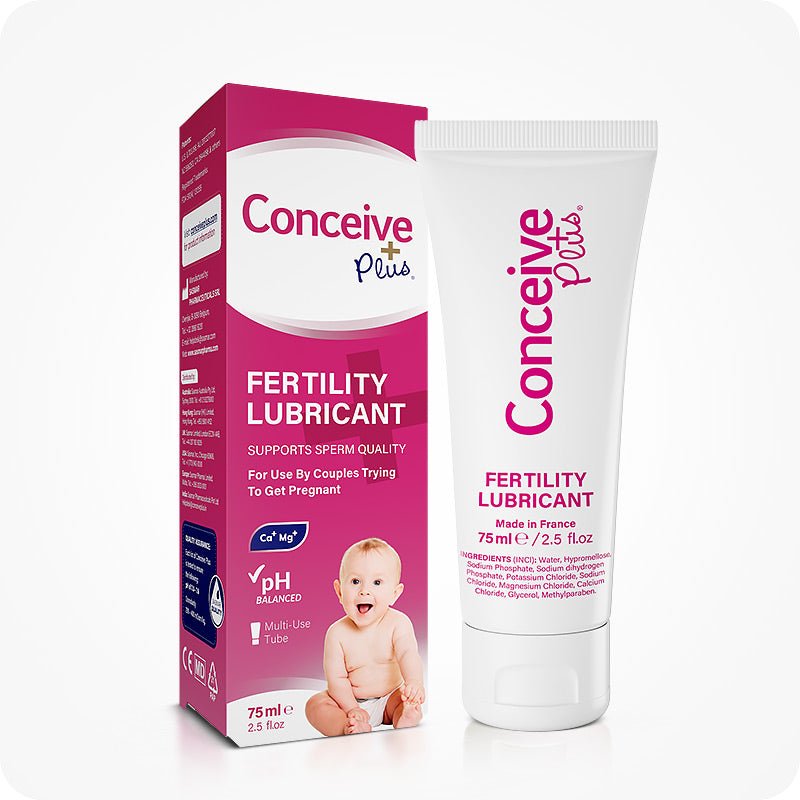
Conceive Plus is proud to be transparent about its formula. The complete conceive plus ingredients list includes:
- Purified Water — Primary carrier, clean and safe
- Hydroxyethylcellulose (HEC) — Smooth, sperm-compatible base polymer
- Sodium Chloride — Osmotic balance support
- Calcium Chloride — Provides Ca²⁺ ions for sperm capacitation
- Magnesium Chloride — Provides Mg²⁺ ions for sperm function
- Sodium Phosphate — pH buffering agent
- Potassium Phosphate — Electrolyte balance
No glycerin. No parabens. No fragrance. No chlorhexidine. Just clean, scientifically formulated fertility lubricant ingredients designed to work with your biology—not against it.
When to Use a Fertility Lubricant and How Often
Even the best sperm-friendly lubricant ingredients won't help if the product is used incorrectly. Here are usage guidelines:
- Timing: Use during your fertile window—the 5 days before ovulation and the day of ovulation itself
- Application: Apply internally 5–15 minutes before intercourse using the included applicators
- Amount: 2–4 mL per use is typical
- Don't mix: Avoid combining with conventional lubricants
- Storage: Keep at room temperature
Frequently Asked Questions About Fertility Lubricant Ingredients
Q: Are all water-based lubricants safe for TTC?
No. Water-based refers only to the carrier medium. Many water-based lubricants still contain glycerin, parabens, or have dangerously high osmolality. Always check the full fertility lubricant ingredients list.
Q: Is coconut oil safe as a lubricant when TTC?
No. Coconut oil has high osmolality and can disrupt vaginal pH and microbiome. It's not recommended as a lubricant TTC safe option.
Q: What makes Conceive Plus different from other fertility lubricants?
The unique addition of calcium and magnesium ions. These ions directly support sperm capacitation—the biological activation process that allows sperm to fertilise an egg. No other fertility lubricant on the market includes these ions.
Q: Can I use Conceive Plus if I have allergies or sensitivities?
Conceive Plus has a minimal ingredient list with no fragrances, parabens, or known sensitisers. Review the full conceive plus ingredients and consult your healthcare provider if you have specific concerns.
Q: Does lubricant affect IUI success?
Yes. Conceive Plus is one of the few lubricants cleared for use in assisted reproduction contexts, including IUI sample collection.
Q: Is KY Jelly safe when trying to conceive?
Standard KY Jelly contains glycerin and has been shown to reduce sperm motility. Most versions are not recommended for TTC.
Q: Does Conceive Plus improve pregnancy rates?
Conceive Plus is designed not to harm sperm—and by providing calcium and magnesium ions, it may actively support sperm capacitation. Clinical studies show couples using Conceive Plus have similar or improved outcomes versus using no lubricant.
Q: Can Conceive Plus be used for sample collection?
Yes. Conceive Plus is one of the few lubricants approved for use during semen sample collection for fertility testing and IUI/IVF procedures.
Q: How long does Conceive Plus stay active after application?
Conceive Plus maintains its sperm-safe formulation for the duration of intercourse when used as directed. Its pH and osmolality remain stable throughout typical use.
Q: What osmolality is considered sperm-safe?
200–380 mOsm/kg is the sperm-safe range. Conceive Plus is formulated at approximately 290 mOsm/kg—right in the optimal zone.
The Bottom Line: Fertility Lubricant Ingredients Are Everything
When you're actively trying to conceive, your lubricant choice is not a minor decision. The wrong fertility lubricant ingredients—glycerin, parabens, chlorhexidine—can silently reduce your chances with every use. The right ones—HEC base, calcium and magnesium ions, isotonic osmolality, physiological pH—actively support the biological conditions sperm need to succeed.
Conceive Plus is formulated with all the right fertility lubricant ingredients and none of the wrong ones. It's the only fertility lubricant on the market to include calcium and magnesium ions, making it uniquely aligned with the science of sperm capacitation.
Don't let your lubricant be the reason a cycle doesn't succeed. Read every label. Know your sperm friendly lubricant ingredients. And when in doubt, choose the lubricant clinicians trust.
Ready to make the switch? Shop Conceive Plus today at conceiveplus.com/collections/fertility-lubricants and give every conception attempt the best possible foundation.
Ready to support your fertility journey? Explore the full Conceive Plus range at https://conceiveplus.com. Trusted by fertility specialists worldwide.